
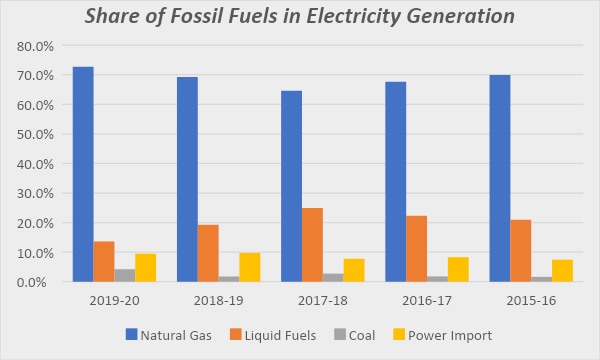
| 2019-20 | 2018-19 | 2017-18 | 2016-17 | 2015-16 | |
| Natural Gas | 72.7% | 69.2% | 64.6% | 67.6% | 69.9% |
| Liquid Fuels | 13.6% | 19.3% | 24.9% | 22.3% | 21.0% |
| Coal | 4.2% | 1.8% | 2.7% | 1.8% | 1.7% |
| Power Import | 9.5% | 9.7% | 7.8% | 8.3% | 7.5% |
Bangladesh’s government started undertaking the reform initiatives to ensure necessary energy supplies for its users to support steady socio-economic development. To promote fuel diversification for power generation, while balancing production costs and electricity tariffs, the government of Bangladesh intends to lower its dependence on natural gas and explore other fuel sources. As the energy mix is set for a radical shift, the country’s current policies suggest that the energy demand will be met by a significant expansion of coal-based energy sources and Liquefied Natural Gas (LNG). Plans of replacing domestic gas with imported coal and LNG will have additional costs such as setting import terminals, storage, and regasification facilities. As such, this shift will ultimately lead to an increase in the overall cost of power generation in the long term and place an additional financial stress on government budgets as well as power consumers. While the unsustainability of fossil fuels has been discussed widely among the country’s energy experts, the reality of its risks has now been brought to the forefront by the recent pandemic. It is important that the country explores renewable energy sources more seriously, and it is doing so as well though not at the pace required.
The prospect of renewable energy in Bangladesh is bright, particularly for solar due to the high solar radiation (4.0 to 6.5 kWh/m²/day). Bangladesh is recognized as one of the first countries in the world to implement Solar Home Systems (SHSs) in reaching consumers outside the national grid (Off-grid) or in places where the grid connection is delayed. And throughout the years, the installed capacity of Solar energy has been increased.
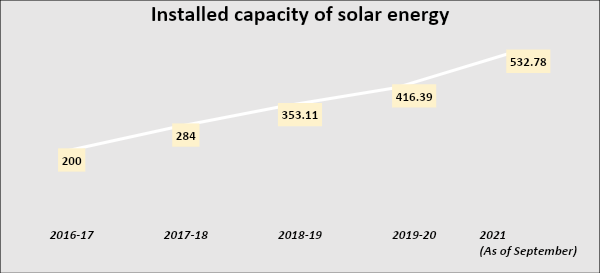
*Figures are in MW unit
Achievement in Renewable Energy Sector of Bangladesh in the last five years:
- Installation of 730 MW capacity power plants/systems from Renewable Energy);
- Installation of 6 million Solar Home System (SHS);
- Replacement of 2225 diesel driven pumps by solar irrigation pumps;
- Implementation of 27 solar mini grid projects;
- Distribution of 10,000 solar systems among the poor people of Chattagram hill tracts and taking projects to bring about 42,000 another poor people under electrification;
- Establishing central database system to renewable energy information;
- Processing 1665.413 MW solar power plant;
- Signing of 200 MW wind power station
- Completion of wind mapping in 13 places;
- Kick off the establishing 1 MW waste to electricity station in at Keraniganj municipality in Dhaka;
- Formulation of “Net Metering Guideline” and installation of 24 MW grid tied solar system under this guideline.
Impact of COVID-19 on Bangladesh’s Power Sector
When COVID-19 started to spread in Bangladesh, the country’s economic growth momentum suddenly faced a downturn. The pandemic consequently caused significant reductions in power demand and revenue. The country’s excessive capacity is also a key contributor to the financial losses suffered. COVID-19 has widened the gap between the power demand and the power generation capacity of the existing power plants. To make matters worse, Bangladesh also has numerous coal-fired plant projects in the pipeline. This combined with plans of additional LNG based power, will leave Bangladesh with the power capacity to generate at least fifty-eight percent more power than needed in 2029-30.
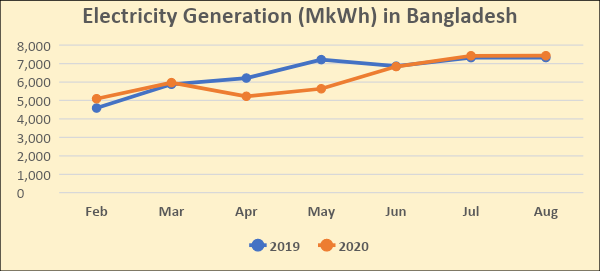
To observe the Covid-19 pandemic effect on Bangladesh’s energy sector, the electricity demand from 2019 and 2020 is shown in the below figure. The electricity demand in March 2020 is found to be higher than in 2019. However, it started declining sharply from April 2020 till June 2020, it is still lower than the 2019 level. This is due to the fact that Bangladesh declared a nationwide general holiday on March 24. However, electricity demand is catching up at a high rate because of the relaxation of general holiday measures in the subsequent period, and in June 2020, it is just below the 2019 level.
Sustainable Renewable Energy: A Way towards COVID Recovery
Compared to fossil fuels, renewable investments are more stable, environmentally friendly, and increasingly cost-effective. Despite the sometimes-high initial costs of infrastructure setup, they offer consistent and predictable returns while delivering greater benefits to the wider economy, society, and environment. Bangladesh’s potential for availing renewable energy options, which has been considered limited due to issues of cost and land availability, is now far more viable than previously anticipated.
As Bangladesh focuses on the long-term gains from availing more flexible renewable energy options, it is important to invest in solutions that overcome some of the existing RE barriers in the country and explore more economically viable opportunities.
Due to the adverse impact on the environment for utilizing fossil fuels, many developed and developing countries are now inclined toward various forms of renewable energy like solar power, wind power, bioenergy, hydropower, etc. More renewable generation options for the electricity generation system in Bangladesh need to be explored. Due to the scarcity of land, it is difficult to achieve a substantial effect through solar generation in the country. There are also other options that require further research, which could be used as potential renewable sources to generate electricity, such as waste to energy schemes.
Cross-border electricity trading might be another option to reduce demand in a fossil fuel-dominated electricity generation system, along with the security of supply. For instance, Bhutan, Nepal, and India have a total estimated capacity of 263 GW hydropower potential. If these renewable energy potentials can be utilized through cross-border energy trading, a large amount of GHGs from the electricity sectors of Bangladesh could be saved.
As Bangladesh is a least developed country, research in the energy management and sustainability field is limited due to many constraints, such as inadequate funding. Thus, a lot of research needs to be conducted to identify potential solutions that could help reduce emissions from the electricity sector. One such area could be waste-to-green hydrogen generation and its application in the electricity generation sector.