The lockdowns under the COVID-19 pandemic have provided much opportunity for the time-constrained human inhabitant of mother earth to gaze at the empty streets and retrospect life under the so-called normal life – hazy streets packed with humans chasing dreams, traffic jam, thick smokes oozing out of factories, sounds of sirens, hovering helicopters and trails left behind in the sky by passing airplanes. Many have even wondered if the pandemic is Nature’s brake on speeding humanity to nowhere. Some have wondered if normal life should be different – a bit less of everything we see around ourselves. I have wondered about the amount of energy that goes into sustaining this normal human life – the generally not so clean energy that is driving climate change. Thinking about the slow pace of global efforts to combat climate change through emission reductions, switching to cleaner energy sources, one would even wonder if restrained human activity would be the ultimate solution to addressing climate change as the single-most threat to life on earth.

With the above disposition in mind, this article dwells on the subject of energy demand and consumption under restrained human activity during the COVID lock downs. In this case, we look at Bhutan in terms of its energy demand and consumption before, during, and after lockdowns.

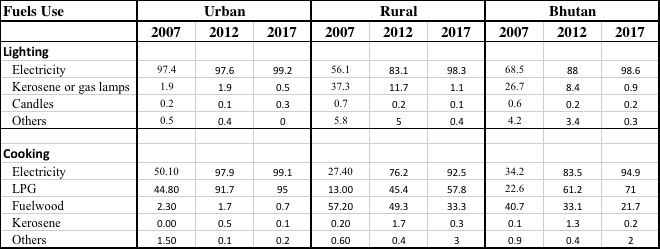
Energy DemandAbout 40% of the country’s energy consumption today is met through electricity, mainly via hydropower plants. Other energy demand is met mostly through fuelwood (traditional biomass), which adds to pressure on the environment, and imported fossil fuels. With rapid economic growth, urbanization and growth in the population, the demand for clean energy is increasing every year.As per the series of Bhutan Living Standard Surveys (BLSS) conducted by National Statistics Bureau, there was rapid increase in the demand/usage of clean energy mainly electricity by both urban and rural households. The BLSS is nation-wide household survey conducted every after 5 years. The change in trend is shown in the table 1.1.

Table 1.1: Proportion of Households using Different Sources of Energy for Lighting and Cooking 2007, 2012 and 2017

Note: For 2012 and 2017 BLSS, the households were asked to report two main sources of energy used for cooking, thus, the total percentage may be more than 100 since most households use multiple sources of energy for cooking.

Energy Production Energy production is defined as the total amount of primary energy produced in the Bhutanese economy measured before consumption and transformation. Domestic energy production in Bhutan includes renewable energies, hydroelectricity and coal. The domestic energy production has increased in 2020 to little more than 1000 KToE from 903 KToE in 2019. The increase in energy production was mainly due to the full commissioning of 720 MW Mangdechhu hydro power plant which started commission in June 2019. The production of renewable energy is further expected to increase in Bhutan with commissioning of 180 KW (installed capacity) solar energy in October 2021 and upcoming hydropower plants.Bhutan imports various energy products, such as fossil fuel (diesel & petrol), aviation turbine fuel, kerosene, furnace oil and LPG. In 2020, Bhutan imported nearly 140 KToE of fossil fuel energy without including electricity and coal. Bhutan mainly exports hydro-electricity and coal to rest of the world (RoW) where Hydro-electricity remains major export with almost 85-97% of the total energy export.

Energy ConsumptionEnergy consumption measures the amount of energy used in the Bhutanese economy. It is equal to indigenous production plus imports minus exports (and changes in stocks). It includes energy consumed in energy conversion activities (such as electricity generation). Although, the domestic energy production has increased by little more than 100 KToE from 2019 to 2020, there was drop in the energy consumption. The overall import of energy decreased by almost 36% in 2020 compared to 2019. The Diesel and Petrol is most widely imported fossil fuels in the country as there is no domestic production. These fossil fuels are mostly used in Transport Sector.

Fossil FuelsThe import of fossil fuel has dropped drastically in 2020. The import of Diesel has dropped by more than 30 percent in 2020 compared to 2019. In absolute term, Bhutan imported only 109.0 thousand Kiloliters of Diesel in 2020 which is least in last five years (2016-2020). Similarly, the import of Petrol has also dropped by almost 30 percent in 2020 compared to 2019. The trend for import of Diesel and Petrol is shown in the figure 1.1.The reason for drop is mainly because of the Covid pandemic. The first Covid case in the country was detected in March 2020. After detection of first Covid cases, there were two nation-wide lockdowns, first one in August and September 2020 and second one in December 2020 and January 2021. There were several lockdowns happened in border towns of Bhutan which has huge impact on the Economic Activities in the country. There was direct effect on Transport sector as the border for tourism remained closed due to Covid pandemic. Most of the industries also remained shut down.

The Gross Domestic Product (GDP) growth rate has decreased by 10.08 percent in 2020. The drop-in GDP growth rate is mainly contributed by secondary sector (Industry sector) and Tertiary sector (Service sector) with drop of 5.04 and 5.50 percent respectively. There was slight increase in primary sector (Agricultural sector) with 0.47 percent. (National Accounts Statistics 2021, NSB).

Figure 1.1: Import of Fossil Fuels (Diesel and Petrol) in thousand KL and import growth rate in percent 2016-2020

Electricity ConsumptionThe Per capita electricity in the country decreased by almost 15 percent in 2020 compared to 2019 from 3162 KWh to 2708 KWh. While the production of electricity has increased by more than 30 percent from 8647.09 MU in 2019 to 11,370.84 Mu in 2020. The primary and secondary sectors (Industry and Service sectors) are affected more by the Covid pandemic in Bhutan. The electricity consumption by the commercial and industrial sector decreased by more than 300 GWh in 2020 compared to 2019. As shown in the Figure 1.2, in recent last four years, the electricity consumption by the commercial and industrial sector is lowest in 2020. However, there is slight increase in the consumption of electricity by the households.

Figure 1.2: Electricity consumption by Commercial and Industrial sector in GWh, 2017-2020

Monthly Electricity Consumption for 2019 and 2020 Observing the monthly electricity consumption for 2019 and 2020 (Covid-pandemic period), there is no much difference in the electricity consumption for Households and Agriculture sector. However, there is observed significant difference in the electricity consumption for commercial and industrial sector and temporary connections (construction sector). There is huge drop in the consumption of electricity in 2020 compared to 2019. This could be mainly because of covid pandemic as the first covid case in Bhutan is detected in March 2020.

As presented in the figure 1.3, comparing month on month consumption, there is little increase in the electricity consumption in February and March 2020 compared to 2019, however, it started dropping from April onwards in 2020. The highest difference is observed in November 2020. There was 35 percent decrease in the electricity consumption in November 2020 compared to November 2019. In August and September 2020 (First Lockdown period), the consumption has dropped by more than 20 percent compared to the same months in 2019.A similar trend is also observed for the temporary connections that are usually found at the construction and mining sites. It indicates that the covid-pandemic has reduced the construction activities in the country. This could be due to banning the import of construction workers and closure of border gates effecting the import of construction materials.

Figure 1.3 Monthly Electricity Consumption in GWh by Commercial and Industrial Sectors, 2019 & 2020.

Figure1.4 Monthly Electricity Consumption in GWh for Temporary Connections, 2019 & 2020

From the above, the lockdowns under the COVID pandemic have perfectly demonstrated restrained human activity as one option to explore for reduction in energy demand and consumption. While this example is for a small national with low population with significant proportion of energy consumption coming from renewable sources, one can imagine the extent of cumulative emission reduction that would have occurred from retrained human activity under lockdowns worldwide. This situation of forced emission reduction paves the way for thinking out of the box to innovate development pathways that address human activity to optimize energy consumption.

South Asia and Vulnerability to Climate Change
Paris Agreement concurs that the world must stop emitting GHG emissions to ensure that the temperature does not rise beyond 2 degree Celsius. Climate change is one of the greatest challenges facing humanity at the moment. The impacts, however, are not uniformly felt across the world. South Asia is one of the important areas where climate change impacts will be felt. According to the recent Climate Change Vulnerability Index (CCVI, 2020), a survey of 170 countries produced by the global risks advisory firm Maplecroft, South Asia and Africa are the ‘most climate-vulnerable’ areas of the globe. Many of the countries therein are designated by the index as being at ‘extreme’ risk over the next 30 years due to sea-level rise, burgeoning populations, and the increasing frequency and intensity of climatic events such as droughts, storms, and floods. Maplecroft’s Fiona Place notes that “[t]he most serious vulnerabilities to climate change are found in a group of developing countries with socio-economic systems ill-equipped to address development challenges such as food and water security, in addition to being burdened by unstable economies and weak institutions.” Very minor changes to temperature can have major impacts on the human environment, including changes to water availability and crop productivity, the loss of land due to sea-level rise, and the spread of disease.

South Asia – Poverty and Calamity
South Asia home to 1.5 million poor people is one of the poorest regions in the world. Besides poverty and inequality, the region is also prone to disasters and calamities. Floods, cyclones, storms, earthquakes, landslides, arsenic poisoning, erosion of soil are some of the common disasters South Asia regularly faces. Climate change and its adverse impacts are also being felt most devastatingly in South Asia(ADB, ND). Both geo climatic conditions, and the all-pervasive poverty and inequality of resources that render people incapable of recovering from the aftermath of the climate impacts makes climate change a serious threat.

Manifestations of Climate Change in South Asia
Climate impacts in South Asia are manifesting in various ways, including extreme events, and changes in climate variables. Cyclones, flooding, and droughts are becoming more intense and frequent, and at the same time climate variables such as temperature means, precipitation patterns are changing in a manner adverse to the historical forms adversely affecting the traditional sectors of livelihood such as agriculture, forestry, fisheries (MPRA, 2009). This makes people lose their livelihood and push millions into ever more acute poverty. It is important, therefore that adaptation actions are undertaken, which will far outweigh the consequences of not doing anything. India and Pakistan are particularly prone to droughts in the arid and semi-arid regions.

Extreme events such as cyclones, and storms are becoming extremely common. They were always persistent, but while now they have become less common, and their intensity has increased causing damage and destruction to the lives of the poor and the vulnerable, destroying their homes, livelihoods and other essential infrastructure such as health centres, water supply and communication infrastructure. The people are mostly poor and unable to recover from the shock of these extreme events.
In 15 November 2007, the notorious SIDR Cyclone(MPRA, 2009) hit more than 22 south and south-western districts of Bangladesh. It killed over three thousand innocent human-beings, beside thousands of animals, cattle, livestock. 2007 of Bangladesh partially destroyed world’s largest mangrove ecosystems of the Sundarbans. Thousands of Sundari tress were uprooted and damaged by the mighty cyclone and the natural coastal fencing for Bangladesh is now really under serious threat. Recently, Amid the second wave of the COVID-19 pandemic, India witnessed two cyclones, Tauktae and Yaas, leaving behind a trail of destruction across several Indian states. The year 2020 marked the first pre-monsoon cyclone in a century– Cyclone Amphan. Another Cyclone, Nisarga, hit the financial capital of India and was the second pre-monsoon cyclone after Amphan. As per IMD, India could witness many other pre-monsoon cyclones in the coming years.
Another very important impact is the rise of sea levels. The recession of Himalayan glaciers has led to reduction in the water provided by it to several rivers in the region(ADB, ND). These rivers are the life blood of these regions, water being provided by them being extremely crucial for the nearby areas. For instance, it impacts agriculture, fisheries and even production of hydropower in Nepal and Bhutan. Another impact of the very same phenomenon is rising sea levels. Cities such as Dhaka, Mumbai, Colombo and countries such as Maldives, Bangladesh and Srilanka face serious threat from sea level rise, so much so that their very existence can be threatened. Sea level rise leads to salt water intrusion into the river making it unfit for agriculture or drinking purposes. Even a marginal change in the global warming may cause a destructive situation for these regions due to sea level rise. Besides damaging economic interests for millions the other worst effect will be the influx of ‘climate refugees’ to other over-burdened areas of South Asia which will also jeopardize the economic, cultural and ecological balance of the region. The future of many areas of South Asia, particularly Maldives, southern coastal districts of Bangladesh and islands and coastal areas of India and Sri Lanka are uncertain.

According to the World Bank, Climate change may increase the possibility of epidemics like malaria by 12-27%, dengue 31-47% and schistosomiasis by 11-17%. Diseases like malaria, dengue, cholera, and hepatitis are some of the commonly found diseases in both urban and rural South Asia and the main reason for such diseases are floods, water poisoning, water logging, among others.

The change in climate means also impacts the biodiversity and ecosystem of the region, which leads us to a devastation and damage of the native ecosystem of the regions causing more problems for people than expected. The damage caused by cyclones and storms did a lot of damage to Sundarbans and also the lives of the people living in the nearby area, impacting the biodiversity of the area.
South Asia’s vulnerability is not just a product of the geo-climatic conditions, but also of the low human development indicators in the region. People poor in resources, with little in terms of savings and alternative livelihoods, live in poor housing conditions in mostly disaster-prone areas, in hugely dense populations. These factors amplify the shock caused by the disasters, or extreme events. The poor have little to recover from in terms of savings or alternative livelihoods. Function of poor socio-economic conditions and geo climate conditions makes the region one of the most vulnerable in the world and impacts not only the extent of the event but also number of people impacted.

South Asian Countries – National Adaptation Plans
It is important therefore that South Asian countries have robust – context specific adaptation strategies. Most nations have drawn up national adaptation plans, which help them deal with crucial climate issues of the region (ADB, ND). India has a National Action Plan on Climate Change , which covers several aspects of sustainable coastal protection and sustainable urban development, which include water and sanitation drainage solid waste management , and road and transport. Nepal completed its national adaptation plan in 2010, which emphasizes improving environmental management and sustainable natural resource use. In Srilanka, Mahindra Chintana 10 year plan recognizes importance of adaptation and emphasizes waste management, infrastructure protection zoning, rain water harvesting and adaptation measures to improve diseases and food security measures.
In Bangladesh, National Adaptation Plan was adopted in 2005 and updated in 2009. Bangladesh is also preparing strategic plans for improving resilience through measures such as fortifying embankments, raising coastlines, improving drainage, connectivity, improving climate water management and food security. Bhutan completed it National Plan of Action in 2006 and largely constituted integrated water resource management, and renewable energy access to the poor. Maldives prepared its Adaptation Plan in 2006, identifying 11 priority areas such as coral reef protection, protection in agriculture, fishery, aquaculture, food security and health. Adaptation to impacts of climate change is a vast area of untapped opportunities in Pakistan due to its multisector nature of economy; huge infrastructure needs; distinct climatic zones, ecological systems, and administrative arrangements. Afghanistan’s INDCs include Development and adoption of the Afghanistan Climate Change Strategy and Action Plan for Adaptation and Development of a system to monitor and assess vulnerability and adaptation to climate change

SAARC regional cooperation as a solution to the problem
South Asian Regional Cooperation can also play a very important role in the process. In the last meeting SAARC held, climate change and its impact on South Asia were discussed among the heads of states who stressed the role of regional cooperation and trade in fighting the problem together. Adaptation, mitigation, climate finance and technology were among many themes discussed. South Asian region needs to fight climate change together was asserted by the countries. Post Covid with economic recession striking many countries, the need to consolidate their economic and political power becomes an imperative but the geo political alignments at present leave this to be something to be desired. The help can especially be in the form of transfer of finance and technology, that can really help poorer countries in the region to not only develop state of the art adaptive technologies but have finance to do so. The money can be given in the form of low interest loans, grants, market rate loans etc. this will help the countries build climate adaptive infrastructure. Another way it can be done is by promoting regional trade in energy. This will help the countries not adapt but prevent further emissions of green house gases in the region, protecting the future from further warming and its implications. India is by far the largest economy of the South Asia region, one of the largest CO2 emitters in the world, and therefore has a crucial role to play in global climate action. South Asia has vast renewable energy potential and utilisation of solar and wind only could satisfy the growing electricity needs of almost all the countries in the regions many times over. Moreover, an energy system transformation towards renewables would have multiple benefits for sustainable development through increased energy security and access to modern energy for all, avoided air pollution damages and reduced or avoided water use, land contamination and environmental degradation.

References

    1. Asian Development Bank, ND, Climate Change in South Asia: Strong Responses for Building a Sustainable Future.
    2. Maplecroft, 2020, Climate Change Vulnerability Index. 
    3. Munich Personal RePec Archive (2009), Climate Change and South Asia: What makes the region vulnerable.


Transportation sector is one of the largest sources of emission (14%) that consumes 27% of energy in Bangladesh. In Bangladesh environmental pollution especially, air pollution is increasing amidst rapid urbanization and industrialization. Air pollution is one of the culprits that intensifies toxic particulates & GHGs in the atmosphere. Bangladesh has been named the world’s most polluted country for PM2.5 exposure while Dhaka has emerged as the second most polluted city in the 2019 World Air Quality Report. Combustible engines’ carbon emission is excessive and one of the culprits of global warming. However, in Bangladesh a silent revolution in energy transition is taking place through Electric Mobility, mostly in the form of electric three-wheelers (e-3Ws).

The global electric vehicle market promises significant growth as concerns for sustainable growth rise around the world. Globally, the mandate for Zero Emission Vehicle dictates that the vehicle should make up 10% of total sales by 2025. According to the International Renewable Energy Agency (IRENA) Electric two- and three-wheeled vehicles could outnumber four-wheeled vehicles, with as many as 900 million on the roads by 2030. As per the International Energy Agency (IEA), electric vehicles will make 40% of all passenger vehicles by 2040. The global auto market is witnessing a held-back demand from many consumers as the horizon clearly points towards the adoption of electric vehicles by 2025. Bangladesh’s growing population and an increasing purchasing power coupled with the government’s concern regarding environmental issues makes it a viable for                                                                                                                         

for booming Electric Mobility.
Micro-mobility, consisting of, but not limited to two- and three-wheelers, is the fastest growing form of transport in emerging markets due to its small size and relative affordability (UNEP, 2021). These e-3Ws have created jobs for 1,500,000 people and carry nearly 10,000,000 people every day.   This growing market has drawn the attention of the Bangladesh government as well and a draft Automobile Industry Development Policy has been drafted  in 2020. Core concerns for the Bangladesh government are sustainable energy consumption, environmental impact and stakeholder benefits to sustain the market. A Local automobile company Bangladesh Auto Industries Ltd (BAIL) is eyeing on setting up EV manufacturing facility in the country.   BAIL envisions to annually deliver 2,00,000 units to EV in the local and international market

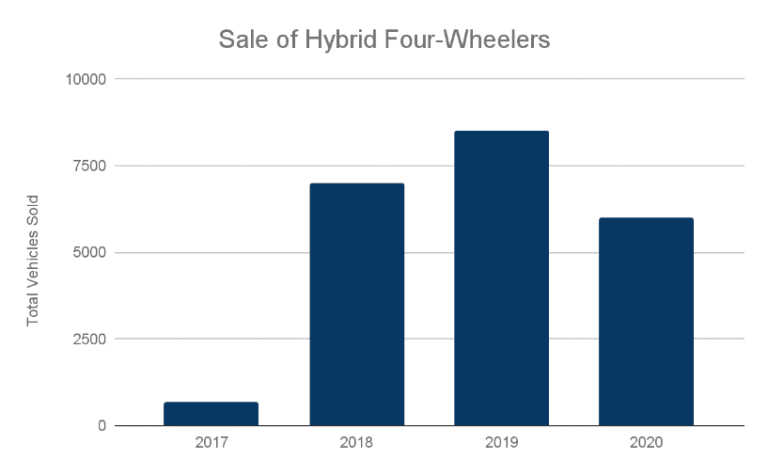
Along with the flourishing of e-3Ws,  over the last few years the demand for hybrid vehicles has also gone up. In terms of volume, the figure had been rising sharply up until the COVID-19 pandemic in 2020.

Credit: LightCastle Partner, Bangladesh

Considering the socio-economic context of the country, these e-3Ws are an ideal mode of transportation due to their inexpensive nature and faster means of transportation considering paddled Rickshaws. Moreover, sharing rides is one of the distinctive features that make this transport more popular as it reduces fare. Also, as a consequence of COVID-19, low income generating people who are lost jobs are inclined to run e-3Ws for earning, resulting in an increase in e-3Ws.

In the context of Bangladesh, Electric Mobility holds the answer to solving the power overcapacity conundrum, which can be mitigated through the adoption of electric and hybrid vehicles. According to the Bangladesh Power Development Board, only 40% of the power generation capacity is currently being utilized in Bangladesh. As per the records, over the last several years power utilization has remained below 50% of the generation capacity and  in the last decade the government has paid a massive US$ 7,000 million as capacity payment penalty to the power producers for simply keeping their plants idle. Introducing EVs and hybrid vehicles in the country can optimize the power generation scenario resulting in more revenue for the government and reduced operational cost for vehicle owners, which is basically a win-win for all.

Even though the source to powering the EVs are conventional fossil fuel-based energy mostly and so far, the country implemented only 14 EV charging stations with a total capacity of 278 kW, powered by solar.  Still, Transition to EVs reduces net carbon emissions and lowers air pollution as compared to fossil fuel powered Internal Combustion Engine (ICE) based vehicles.

Poor charging infrastructure is one of the biggest bottlenecks for the growth of e-3Ws. It takes 8-10 hours to charge a e-3Ws and due to unstable grid electricity, in most of the cases only 30-40% of the battery capacity can be charged.  To facilitate the adoption of greener and cost-efficient EVs in Bangladesh, accessible and robust charging infrastructure is a prerequisite. Technological development and introduction of fast charging technology can be a groundbreaking solution for sustainable Electric Mobility. In this context and having net metering in practice, using the surplus energy of the Solar Irrigation pumps (SIP) for charging EVs can be a great combination. So far Bangladesh has installed 2,240 nos of SIPs with installed capacity of nearly 50MWp and in the current practice more than 70% of generation capacity of the SIPs are utilized.

The possibilities in the field of Electric Mobility in Bangladesh is immense. Developing industrially while taking care of the environment is essential, and electric vehicles provide that exact opportunity. In parallel to this increasing flux of Electric vehicles,  injecting more renewable energy sources in the energy mix would ensure cleaner means of transportation in future and net GHG reduction.

Mome Saleem and Ayesha Majid

Climate change impacts have no geographical boundaries, and hence the solution to the problem cannot be limited to one country’s policies and actions. South Asia lacks integrative approach to development owing to the geopolitical issues that hinder collaboration on almost all fronts. At the same time the region is plagued with social, economic and environmental issues and have limited financial resources.

On climate crisis front as well, South Asia is one of the most vulnerable regions with two of its countries namely Pakistan and Bangladesh ranked among the top ten most vulnerable countries to the impacts of climate change by The Germanwatch’s Long-Term Climate Risk Index[1] . Countries in the region are not major emitters of greenhouse gases, yet nearly half of the population in the region has been negatively affected by climate-induced natural disasters during the last decade[2] . Pakistan has faced climate induced disasters since 2000. Droughts in Balochistan led to displacement of a large number of people. Similarly, the 2010 floods impacted around 20 million people[3] . Villages in Bangladesh experienced river erosion and many lost their households, while heat waves killed about 6,167 people in India from 2000 to 2018[4] . The situation is expected to get worse amidst continuous rise in average temperatures and shifting weather patterns that will impact the natural resources and topography in the region. This will increase the risk of natural disasters, which in turn, will have a bearing on the large proportion of the population that is dependent on climate-sensitive sources of livelihoods. Socioeconomic security of the region will be threatened as a as well since the most severe impact of climate change cut across national boundaries due to shared topographic features.

As the impacts of climate change and environmental degradation intensify, the countries in the region need to recalibrate their approach towards addressing the issue. Individual adaptation and mitigation strategies, although necessary, are no longer sufficient to tackle the scale of the problem. A broader mechanism is required instead. The framework could include the following pillars;

          1- Knowledge Exchange and Assistance: Countries in the region are working on finding and implementing adaptive and mitigation measures. Exchanging knowledge and assisting in finding solutions that work are crucial for bringing the less prepared countries at par. Early warnings systems were to be placed under The Indus Water Treaty, however, due to ongoing tensions in the region, especially India and Pakistan the systems are not functional.. Therefore, there is a need to negotiate terms of efficient shared monitoring and early warning systems to prevent natural disasters such as floods, sharing of status around glacier melt and health and landslides. Collaborative and comparative research for finding solutions and scaling up local wisdom which has worked to adapt to and mitigate climate change impact is also important.

          2- Expanding Use and Export of Clean Energy: The South Asian region holds massive potential for energy production through renewable resources such as solar and water. Bolstering the process of clean energy development and regional energy trading will reduce the region’s dependence on fossil-fuel based sources of energy. It will also alleviate the associated issues air pollution.

Following the footsteps of Europe, a regional grid could improve energy issues and reduce emissions from energy production in the long run. These benefits will also be transferred to the transport sector which at the moment significantly contributes to the emissions.

          3 – Collective Approach for Mobilizing Green Financing: Countries in the region are individually making efforts for ecosystem restoration. As many of shared topographic features such as glaciers, rivers and mountains could be jointly preserved, regional actors could leverage it for gaining better access to global green financing. Joint efforts for carbon sequestering could also be undertaken. Such initiatives will improve livelihoods, reduce the overall risks of natural disasters, and contribute towards achieving sustainable development.

          4 – Investing in Youth for Eco-innovation an Integrated Skills Development through Education: South Asia has a large number of young people with almost 627 million under the age of 18 years. In order to transition towards greener and sustainable future, it is important to invest in young people and provide them with opportunities and platforms during formative years that could help South Asia transition towards sustainable development. As innovation is a key to finding solutions to climate problems, it is utmost that a lifecycle approach to young people’s development is taken at regional level. Education with green skills followed by transition to job placement or/and green entrepreneurship could revamp the landscape not only in South Asia but could help the region take leadership at global level. Exchange programs at university level, regional green innovation challenges, mainstreaming environment and climate change as a subject at school and college level, exposure visits to impacted places, regional afforestation drives and regional mentorship are some of the low hanging fruits in this regard.

Going forward, partnerships and sustained collaborative efforts will be critical for ensuring transition towards low carbon and climate resilient development. In this regard, apart from Track-I diplomacy it is important to promote and facilitate Track – II dialogue which could lead to collaborations and partnerships across the region. Important actors in this regard are the civil society which includes segments such as journalists, think tanks, NGOs, academia and the private sector. Given the increase in digital platforms, it is crucial to engage the actors in dialogues which, could lead to a) research ideas and comparative analysis of the landscape, b) exchange of knowledge and lessons, c) youth collaboration for innovative solutions, d) seed new ideas by providing youth with co-creation platforms and e) dissemination of information to educate the masses. 


[1] https://germanwatch.org/sites/default/files/Global%20Climate%20Risk%20Index%202021_2.pdf

[2] https://foreignpolicy.com/2021/08/12/south-asia-climate-ipcc-report-front-lines/

[3] https://www.csis.org/analysis/south-asia-monitor-pakistan-floods-internally-displaced-people-and-human-impact

[4] https://www.indiaspend.com/india-underreports-heatwave-deaths-heres-why-this-must-change/

Nepal, a country that struggled with power shortage and experienced almost 16 hours a day load shedding in 2015, has not only become self-sufficient in electricity, but also possesses around 400 MW of surplus electricity unconsumed in the night. The power generated from Upper Tamakoshi Hydro Power Project in Central Nepal’s Dolakha District with maximum output of 456 MW contributes to this surplus. The project was connected to the national grid recently.

Nepal has also made significant progress on per capita electricity consumption rates. The per capita electricity consumption per year has reached to 260 kWh[1]  as of March 2020 against 80 kWh in 2015. The government aims to provide electricity to every household by 2022 and increase electricity consumption to 700 kWh per person within four years (from 2021?). To implement the government’s policy to increase electricity consumption within national market, Nepal Electricity Authority (NEA) is encouraging the use of electric stoves and vehicles, for which NEA is strengthening, upgrading and expanding its infrastructure to accommodate these desired loads. Further, the government has exempted value added tax (VAT) to support e-cooking sector. This would address problems of majority of the households (71.6%) in Nepal that still use solid biomass, mainly firewood for cooking.

However, various barriers prevent wider adoption for electric cooking in Nepal. Private sectors are not yet confident about contextual understanding, especially in terms of food preferences, cooking practices, fuel / stove stacking, capacity to pay, etc. Therefore, there is an urgent need to establish bold policy action facilitating a faster penetration of private sector to support transition to more accessible, affordable and sustainable electric cooking for all.
The needs are presented below based on our engagement in research, studies and a demonstration project. The year 2020 was a year of electric cooking not only for us but for the entire cooking sector, where evidence generation through research, studies, demonstration projects were implemented (seems repetitive based on the first line of this para). Encouraging households to use electricity for cooking is on strategic priority of many civil societies, private sectors, media and academicians.

Dev Laxmi Shrestha, one of the participant households of a research carried out by Practical Action for Modern Energy Cooking Services (MECS) in Kavre, is very happy with the induction cook top. Further, “market assessment of e-cooking appliances” conducted by Practical Action found that liquefied petroleum gas (LPG) users would be the first ones to transit to electric cooking. However, a critical hurdle in the shift from traditional biomass to electric cooking has been price. Electricity tariff and supply reliability are crucial in transitioning to electric cooking. Therefore, if we want biomass users to shift to electric cooking, targeted incentives have to be introduced for very poor and disadvantaged group. It is also found that stacking of stoves will continue for years. As such, our aim should be to replace all dirty fuels with clean fuels, clean stacking should be ok.

While there has been good progress in the last decade regarding knowledge dissemination of the negative impact of inefficient cooking practices, households are not readily moving towards cleaner form of cooking energy. Affordability is one of the key reasons behind this. Low-income households often have firewood as the only affordable choice when it comes to cooking. Therefore, relying on electricity for it is an expensive choice for the households. Further, it has been observed that managing peak electricity demand is going to be challenging for utility and local electricity service providers. Demand side management, corresponding tariffs and incentives to encourage demand side management will play a significant role to make this shift happen promptly. We have seen that households struggle to receive standard quality voltage during peak time in rural areas.

A multi-pronged approach is needed for faster transition. Making a rapid transition to clean cooking for all will have an enormous impact on women’s life. While external support can help to strengthen the market of electric cook stoves by ensuring guarantees, after sales services, training, awareness on benefits, incentives to create last mile distribution chain; there is an urgent need from NEA to ensure Tier 5 electricity access in all parts of the country very soon. To address the affordability issue, linking with local financing institutions, making affordable credits accessible to all, lowering the cost of products through VAT exemption and most importantly, integrating income generating activities (IGA) in electric cooking initiative or tying up with some other such IGAs would be beneficial for electric cooking wider update. This requires a buy-in of and contribution from multiple stakeholders beyond energy sector stakeholders. It also calls for establishment of an effective framework of planning and coordination. We are expecting that the national clean cooking strategy currently being developed will support to facilitate coherent planning and investment, clarify the roles of different tiers of government, and facilitate multiple stakeholder coordination.

Although Nepal has made significant progress towards achievement of electricity access for all, well ahead of 2030 target, current efforts for clean cooking development remain well below 2030 target. Therefore, we must act very quickly and decisively now!


[1] SDG Progress Assessment Report 2016-19