
In acknowledgment of the global concern and the need for concerted efforts to combat climate change, the Royal Government of Bhutan, pledged to remain carbon neutral at COP15 of UN Framework Convention on Climate Change. This commitment was further reiterated at the time submitting its Nationally Determined Contribution (NDC) to the Paris Agreement in 2015. At that time, Bhutan’s greenhouse gas emissions (including forest emissions) was estimated at 3.8 million tons of CO2. Through its consistent efforts on sustainably forest management and environmental conservation, Bhutan has always maintained over 70% of its area under forest cover. Carbon sequestration by its forests in 2015 was estimated at 9.4 million tons of CO2 resulting in net negative emissions of 5.6 million tons of CO2. Of the total carbon emission of 3.8 million tons, more than 50% was attributed to Agriculture, Forestry and other Land use, around one-fifth (20.9%) from Industrial processes, nearly 20% from the Energy and the remaining 3 percent was attributed to waste and waste related products (See Figure 1 below)
Figure 1.1 Proportion of GHG emission by different sectors in percent, 2015.
The Kingdom of Bhutan’s second Nationally Determined Contribution of 5th June 2021 outlines the following sector wise mitigation measures for carbon emission reductions:
Agricultural, Forestry and Other Land Use: With 50% of the country’s GHG emissions attributed to this sector, the proposed mitigation measures are as follows:
-
Switching from synthetic to organic fertilizers
-
Improving agricultural practices
-
Increasing biomass through increased perennial crop production
-
Reduction of continuous rice flooding
-
Improving dairy cattle production through breed improvement and feeding management
-
Rolling out the solar PV systems on buildings
-
Replacement of LPG and firewood with electricity, etc.
Industries: Although the industrial sector contributes to over 20% of the country’s carbon emissions, appropriate mitigation measures need to implemented to prevent further increase in emissions. One of the main mitigation measures proposed for this sector is to replace fossil fuels with renewable sources of energy. Further, in order to stimulate economic growth, foster private sector development, and generate employment, fiscal incentives in the form of direct and indirect tax incentives were provided under the Fiscal Incentives Act of Bhutan 2017. Industries adopting modern environmentally friendly technologies are incentivized with tax rebates while tax exemptions are provided to entities promoting hydroelectricity, solar, wind, biogas and other renewable energy sources.
Energy Sector: Enhanced clean energy production continues to be an option for averting GHG emitting enterprises and businesses. Continued emphasis on production of renewable energy remains a major avenue for achievement of carbon neutral status. Bhutan generated 11,370.80 MU electricity in 2020. With four hydropower projects due for commissioning before 2030 i.e., Punatsangchuu-I (1200MW), Punatsangchhu-II (1020MW), Kholongchhu (600MW) and Nikachhu (118MW) hydroelectric projects (HEP, one can expect much of the energy to go into offsetting carbon emissions outside as well as inside the country.
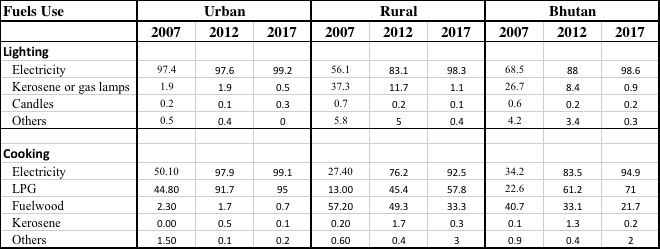
With an aim to reduce the dependency of rural residents on firewood, the pursuit of alternative renewable energy program consisting of mini hydro, solar, wind and waste-to-energy technologies have been identified as priority programs. Further, in line with this policy, the Royal Government of Bhutan recently launched the 180kW grid-tied ground mounted Solar Photo-Voltaic Power Plant in Bumthang district. As it is, there is observed reduction in usage of firewood over the years owing to increased availability of clean hydroelectricity for both lighting and cooking purposes. As per the series Bhutan Living Standard Surveys (BLSS), the proportion of households using electricity for the cooking purpose has increased by almost three time in ten years from 2007 to 2017. Whereas the proportion of households using fuel wood has decreased by almost half in the same period (see Figure 2).
Figure 2: Proportion of Households using Electricity and Fuel wood for Cooking Purposes 2007, 2012 and 2017.
Note: Cases where total proportion exceeds 100 percent is explained by households having reported use of multiple sources of energy for cooking.
Transport sector, on the other hand is a major contributor of contributing emissions from burning of fossil fuels. As per the Annual Info-Comm and Transport Statistics Bulletin (12th Edition, 2021), the number of motor vehicles is increasing every year. During the period 2010 to 2020, the number of vehicles has more than doubled from 53,382 to 112,058 accounting for an average 8 percent increase per year (see Figure 3).
Figure 3: Total Number of Vehicles from 2010-2020
Source: Ministry of Information and Communication
Therefore, the following mitigation measures have been proposed to reduce the emissions from the transport sector
-
Mass transit though improvements in bus systems and the introduction of open-bus rapid transit (BRT) network (electric and diesel) and light rail transit.
-
Promotion of electric passenger vehicles (taxi, two wheelers, light vehicles, buses)
-
Low emission freight transport system for heavy and commercial trucks and freight trains
-
Improve fuel-efficiency in internal combustion engines through stringent vehicle and emission standards.
Accordingly, there was observed increase in the import of Electric Vehicle in the country. The recorded number of Electric vehicle has increased to 133 numbers in 2020 against the 94 in 2017 as per Annual Info-Comm and Transport Statistics Bulletin.
Waste management: Emissions from improper disposal and management of landfill sites has been identified as another potential area for carbon emission reduction. With rapid economic diversification and growth in population, the associated increase in generation of waste contributes to almost 4 percent of total national emissions. The Royal Government of Bhutan, under the National Waste Management Strategy 2019, and the Waste Management and Stray Dog Population Control Flagship Program has set the goal of revering the current trend of disposing over 80% to the landfill to less than 20% by the year 2030. Measures proposed under the Flagship program include:
Introduce colour-coded waste bins for all households.
Ensure end-to-end reduction of waste.
Private sector partnership in recycling and converting waste into profit.
In pursuit of its pledge to remain carbon neutral, Bhutan has consistently endeavored to put in place the policies and programmes necessary to maintaining the country on the path to carbon neutral economy. Progress made on implementing climate actions since the ratification of the Paris Agreement may be tracked in terms of the following:
Integration of climate change concerns into development planning
The 12th FYP has a National Key Result Area (NKRA) dedicated to addressing climate priorities of the country. The 6th NKRA “Climate Neutrality, Climate and Disaster Resilience” translates the priority areas for mitigation and adaptation identified in the NDC into programs for implementation across different sectors at the national and local levels. Among other climate and climate related projects, the following projects are being undertaken:
The third NAPA project ‘Enhancing Sustainability and Climate Resilience of Forest and Agricultural Landscape and Community Livelihoods in Bhutan’ funded by the LDC Fund
‘Bhutan for Life’ pertaining to managing the network of Protected Areas in Bhutan funded by Green Climate Fund (GCF).
‘Supporting Climate Resilience and Transformational Change in the Agriculture Sector in Bhutan”, also funded by GCF seeks to addresses the adverse impacts of climate change on rural livelihood security and poverty, and the effects of sector-led development practices on the ecological integrity of biodiversity-rich forested landscapes.
‘Local Climate Adaptative Living Facility (LoCAL)’ with funding from UNCDF and the EU focuses on mainstreaming climate adaptation into local development.
Formulation of a National Adaptation Plan (NAP) and establishing and strengthening of the supporting elements for the NAP process funded by GCF under its NAP readiness support.
Preparation of the Long Term Low GHG Emission and Climate Resilient Development Strategy (LTS)- aimed at formulating overall direction and guidance for Bhutan in the long-term efforts for remaining carbon neutral.
Direct access modalities for climate finance: Accreditation of the Bhutan Trust Fund for Environmental Conservation (BTFEC) as National Implementing Entity to both the GCF and the Adaptation Fund. In addition, Bhutan is pursuing access for the private sector with three financial institutions (Bhutan Development Bank Ltd, Bank of Bhutan Ltd and the Bhutan National Bank Ltd) undergoing the accreditation process for access to the Private Sector Facility of the GCF.
Policy initiatives
The Constitution of the Kingdom of Bhutan sets the nation’s priorities for sustainability through preservation of the environment and sustainable use of natural resources. For this, the constitution mandates that the Kingdom of Bhutan will maintain a minimum of 60 percent of total land under forest cover for all time. Under this overarching mandate, there are ongoing effort to put in place climate friendly policies. Some of the prominent policies that the Royal Government has put in place since its ratification of the Paris agreement are listed below:
Climate change policy, 2020: The Climate Change Policy of the Kingdom of Bhutan was adopted in 2020. The policy envisions “a prosperous, resilient and carbon neutral Bhutan where the pursuit of gross national happiness for the present and future generations is secure under a changing climate.” The policy aims to i) provide strategic guidance in maintaining a carbon neutral economy, ii) foster coordinated and coherent stakeholder participation in climate actions, iii) address climate change related challenges and opportunities at all levels by integrating climate change into relevant policies through adequate means of implementation i.e., finance, technology, and capacity building.
The Kigali Amendments to the Montreal Protocol on Ozone Depleting Substances ratified: Bhutan ratified the Kigali Amendments to the Montreal Protocol on Ozone Depleting Substances in 2019. In addition to the system for licensing the import and export of HFCs that is already in place, the Regulations on Control of ODS 2008 are being amended.
Fiscal Incentives: Following the Economic Development Policy 2016, fiscal incentives were provided for environmentally friendly technologies and equipment; Waste management and recycling industries were provided income tax holidays and exemption of sales tax and custom duties on plant and machinery related to waste management and recycling industries
Following the Economic Development Policy 2016, fiscal incentives were provided in the form of direct and indirect tax incentives under the Fiscal Incentives Act of Bhutan 2017 to stimulate economic growth, foster private sector development, and generate employment. Incentives included tax rebates to industries adopting modern environmentally friendly technologies, tax exemptions to hydroelectric projects, solar, wind, biogas and other renewable energy plants and machineries. Energy efficient and environment friendly equipment were also exempted from import duties for targeted sectors such as hotels. Waste management and recycling industries were provided income tax holidays and exemption of sales tax and custom duties on plant and machinery.
The National Energy Efficiency & Conservation Policy covering the sectors of buildings, transport and industry were launched in 2019. The policy aims to facilitate improvements in productivity and energy efficiency while contributing to Bhutan’s efforts to remain carbon neutral. Further the Renewables Readiness Assessment (RRA) has been developed in cooperation with International Renewable Energy Agency with a view to complement the country’s efforts in enabling the wider penetration of various renewable energy technologies.
The Sustainable Hydropower Development Policy (SHDP) 2021 enhances the previous hydropower policy by integrating climate resilience and mitigation among other updates. As current run-of-river hydropower schemes in Bhutan have become increasingly vulnerable to decreasing water flows in the dry season the SHDP emphasises adaptation measures such as reservoir/pumped storage schemes. In addition, the new policy mandates hydropower value chain through ventures in energy storage technologies such as hydrogen fuel, green ammonia, and other emerging technologies. These energy storage and diversification measures for adaptation also contribute directly to Bhutan’s carbon neutral efforts by providing clean energy for zero carbon transport and mobility.
Low Emission Development strategies, plans, and Roadmaps
To implement the priority programs in the NDC, several Low Emission Development Strategies (LEDS) and roadmaps have been developed to prioritise mitigation actions in key sectors of Agriculture, Human Settlement, Industry and Transport. The LEDS developed so far include a) Forest conservation and management under the National REDD+ Strategy, b) Low Emission Development Strategy for Food security, c) Low Emission Development Strategy for Human Settlement, d) Low Emission Development Strategy for Industries, e) Low Emission Development Strategy for Surface Transport, f) Waste Management, g) Sustainable Hydropower Development, h) Alternative Renewable Energy, i) Green Hydrogen Roadmap., j) Energy Efficiency Roadmap 2019. These LEDS will guide the concerned sectors to integrate low carbon measures into development priorities.
In addition, other climate related strategies and roadmaps have also been developed. They are:
National Environment Strategy Strategy 2020, which is the updated version of the National Environment Strategy of 1998. The strategy integrates new and emerging national environmental challenges and the critical global challenge of climate change and outlines strategic measures to managing land, air, water, and biodiversity with climate change as a cross cutting issue.
The Renewable Energy Master Plan (2017-2032) was adopted as a strategy for the long-term implementation of renewable energy technologies. This master plan identified 39,462 MW of technically feasible small hydropower, solar and wind projects across the country. These renewable energy technologies provide a basis for both clean energy generation for mitigation and as adaptation to changing water flows and the impacts on hydropower in Bhutan.
The Bhutan Electric Vehicle (EV) Roadmap (2020-2025) promulgates gradual transition to zero emission by 2035, 2045 and 2050. Part of this strategy is already being implemented in the form of the project ‘The Bhutan Sustainable Low- emission Urban Transport System’ which targets taxis for EV mobility.
The National Waste Management Strategy, which was adopted in 2019, seeks to address emission from landfill sites by reversing the current trend of disposing over 80% of solid waste to the landfill to 20% by the year 2030.
The Renewable Natural Resources (RNR) Strategy 2040, covering the forests, agriculture, and livestock sectors, was adopted in 2021 and covers the AFOLU sector under the IPCC emissions source category. The RNR Strategy integrates resilience to climate change and low emission development supplementing the REDD+ Strategy, LEDS for Food Security 2021, and the National Strategy for Sustainable Socio-economic Development.
Roadmaps currently being formulated that take into account priority areas integrating climate change concerns into economic development needs are i) 21st Century Economic Roadmap which is expected to chart the direction for Bhutan’s long-term economic development and ii) the Green Finance Roadmap that will address sustainable financing mechanisms to support the priorities identified in the 21st Century Economic Roadmap.
Enhanced Coordination mechanism
Climate Change Coordination Committee (C4) instituted: The national mechanism for coordination of climate change actions has been strengthened. The erstwhile Multisectoral Technical Committee on Climate Change was revitalized into Climate Change Coordination Committee (C4). Efforts are underway to set up a ‘one stop platform’ for coordination of multi-stakeholder dialogues and implementation of climate projects in the country.
Having the policies and plans for a Carbon Neutral Economy is one thing and translating the policies and plans into action are entirely another thing. As a least developed country (LDC) with stretched financial resources that has further suffered badly from the economic and financial impacts of COVID-19 pandemic, it is even more understandable that the country’s NDCs have been proposed as subject to adequate external funding. Hence, it is reasonable to expect the country to rely on bilateral and multilateral climate funding to meet its climate commitment.
References:
RGOB, 2021. Kingdom of Bhutan: Second Nationally Determined Contributions. Royal Government of Bhutan, 5th June 2021.
MoIC, RGOB 2021. Annual Info-Comm and Transport Statistical Bulletin (12th Edition, 2021), PPD, MoIC, RGoB
National Statistics Bureau, RGOB. Bhutan Living Standard Surveys 2007, 2012, 2017. National Statistics Bureau, RGoB